 ZHICHENG BIO
Flavonoid ActivesBy project
Fisetin
98% (HPLC) · CAS 528-48-3
Quote on requestRFQ
Bulk (2R,3R)-dihydromyricetin from vine tea. The industry spec is achiral “HPLC ≥98%”, which cannot tell a single enantiomer from a racemate. We will report enantiomeric ratio and specific optical rotation on the batch certificate.
Zhicheng Bio supplies bulk dihydromyricetin (DHM, ampelopsin; CAS 27200-12-0) at 98% by HPLC from Shanghai, China, and will additionally report optical purity by chiral HPLC or SFC together with specific optical rotation. That second measurement is the point. A conventional “98% by HPLC” figure is produced on an achiral reversed-phase method, which by construction cannot distinguish (2R,3R)-DHM from its enantiomer — so a standard 98% certificate is silent on stereochemistry even though published work links configuration to activity. Zhicheng Bio also supplies the vine tea (Ampelopsis grossedentata) leaf polyphenol grade at ≥85%.
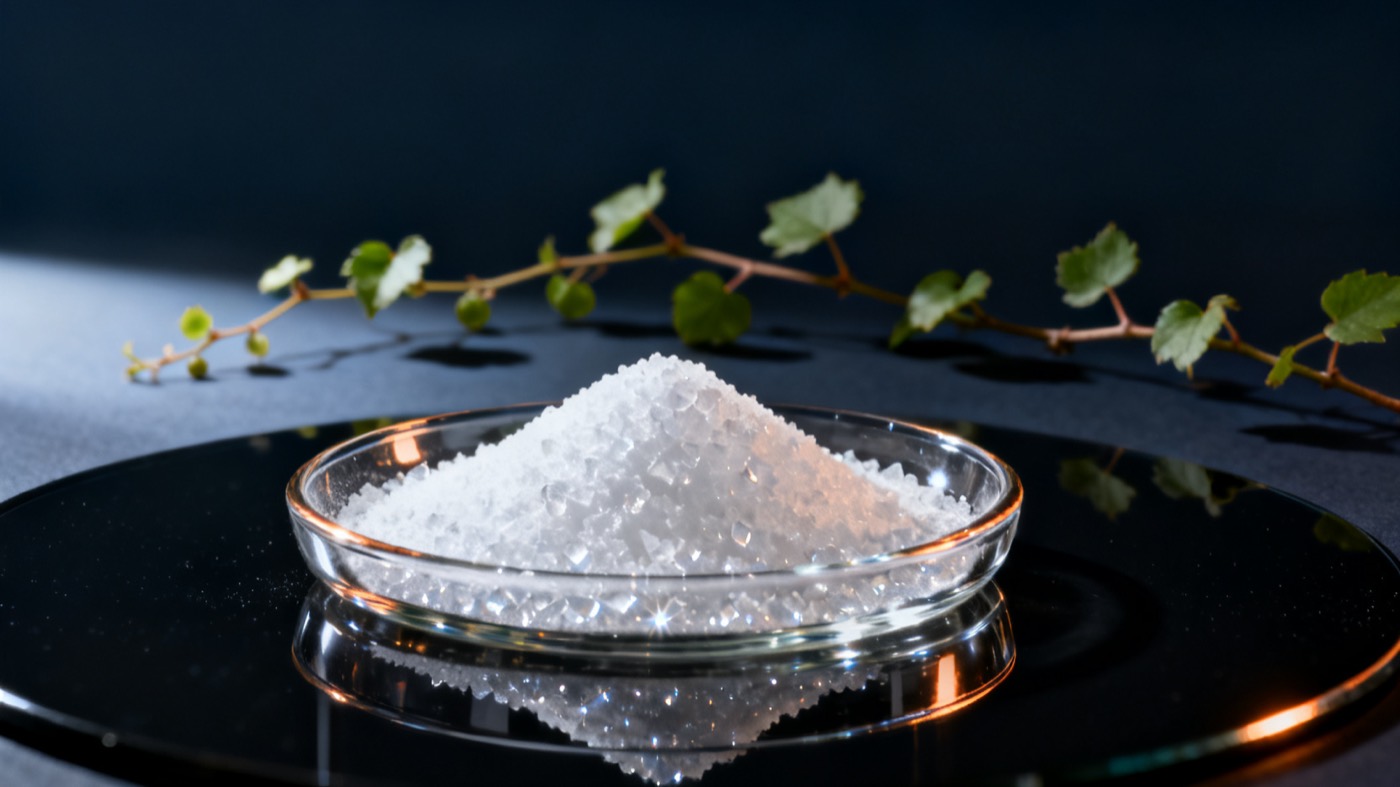
Bulk dihydromyricetin (DHM, ampelopsin) for B2B manufacturing, from vine tea leaf. The whole industry quotes this material as “HPLC ≥ 98%”. That number is achiral — ordinary reverse-phase HPLC cannot separate DHM's enantiomers, so it is silent on whether you are buying (2R,3R)-DHM or a racemate. On request we report enantiomeric ratio by chiral HPLC or SFC and the measured specific optical rotation on the batch certificate. There is no price on this page: this material is quoted per project.
We do not publish an indicative range for this material: it is quoted per project against your target specification, quantity and analytical package. Send an RFQ and we reply within one business day.
Third-party lab verification can be arranged pre-shipment on request. Certificates of origin, non-GMO or allergen statements per destination-market requirements.
COA per batch, Spec Sheet and MSDS — reviewed by your QA before anything ships.
Multi-tonne inventory on core SKUs, plus 28 actives held in our US warehouse in Los Angeles for domestic delivery.
Sourced from audited, certified manufacturers — ISO, HACCP, Halal & Kosher available.
25 kg bags, cartons or drums; FOB / CIF / DDP by lane, sea or air consolidation.
Identity, source plant, and why two chiral centres change how this material has to be bought.
Dihydromyricetin (CAS 27200-12-0; C15H12O8; MW 320.25; UNII KD8QND6427), also written DHM, DMY or ampelopsin, is a dihydroflavonol. Its full stereochemical name is the part that matters: (2R,3R)-3,3′,4′,5,5′,7-hexahydroxy-2,3-dihydroflavonol. The molecule has two chiral centres and therefore four theoretically possible stereoisomers, and only the (2R,3R) form occurs in nature.
The commercial source is vine tea — Nekemias grossedentata (Hand.-Mazz.) J. Wen & Z. L. Nie, formerly Ampelopsis grossedentata, in the Vitaceae — grown mainly in Hubei (Laifeng) and Hunan (Zhangjiajie, Yongding) and known locally as 藤茶 or 莓茶. A second botanical source, Hovenia dulcis, the Japanese raisin tree, is what many overseas products actually declare. What makes vine tea unusual as a raw material is how concentrated it is: DHM has been reported “as high as 35%” in A. grossedentata, around 20% of dried leaf across several production areas (21.42%, 20.17% and 16.47% in three surveys), and the 2025 near-complete genome paper puts DHM at about 35% of total flavonoids, accumulating most in young shoots.
Supply behind it is real rather than notional. Laifeng County in Hubei reported 102,000 mu under cultivation in 2025 — up from under 2,000 mu in 2012 — across 8 townships and 110 villages, with 91 producing enterprises and 46 processing plants, and flavonoid extraction yield improved from 60% to 90%; a single local producer reports 150 tonnes per year of flavonoid output. Yongding District in Zhangjiajie reports more than 150,000 mu. For a buyer, this matters in a specific way: raw material at 20–35% active content, in a region with this much processing capacity, means the constraint on quality is not availability. It is process control.
Published purification routes agree on what the difficult part is. Cooling crystallisation — ethanol below 10%, solvent above 85 °C, 0.1–0.3% activated carbon for 1–3 minutes — has been reported to give above 70% yield at above 98% content, with productivity collapsing if the temperature is dropped too fast. An ACS Omega 2020 method introduces Zn²⁺ chelation specifically to stop the molecule oxidising during extraction and purification. Ceramic-membrane filtration followed by vacuum concentration and crystallisation is claimed in CN110201067B. The process registered with China's 2026 new food ingredient approval is leaf, then ethanol extraction, decolourisation, concentration, filtration and drying.
This is the genuine differentiator on this material, and it is a measurement, not a marketing line.
The standard commercial specification for DHM is “HPLC ≥ 98%”. That figure is achiral. Ordinary reverse-phase HPLC cannot separate DHM's enantiomers, so a certificate showing 98% by RP-HPLC says nothing about whether the material is (2R,3R)-DHM or a racemate. The literature is explicit that some products sold as (+)-DHM are in fact racemic, because small changes in temperature, pH and metal-ion content during extraction and crystallisation are enough to flip configuration.
The kinetics were mapped systematically in J Food Sci 2024 (PMID 38745380). Temperature above 80 °C markedly accelerates racemisation and 100 °C accelerates it dramatically. Ultrapure water was the most stable medium tested; purified, mineral and tap water were all worse. Fe²⁺ suppresses racemisation, while Mg²⁺, Ca²⁺ and Mn²⁺ significantly promote it. pH below 5.0 protects the configuration and pH above 9.0 destroys it. The same paper identified a further pair of DMY isomers for the first time.
There is a reason this goes beyond purity theatre. Semi-preparative supercritical fluid chromatography has been used to separate DHM enantiomers and to compare their anti-inflammatory activity in vitro, and the enantiomers were not equivalent (J Chromatogr A 2019). If measured activity differs by configuration, then configuration is a quality attribute — and at present it is neither specified nor priced anywhere in the trade.
So this is what we offer, and it is the reason to buy this material from us rather than from a listing. On request we will report, on the batch certificate: enantiomeric ratio / optical purity by chiral HPLC on a polysaccharide-coated chiral stationary phase with hexane–ethanol, or by RP-HPLC with a β-cyclodextrin mobile-phase additive, or by SFC; together with the measured specific optical rotation, stating solvent and concentration. We deliberately do not publish a target rotation value, because we could not verify a reference figure for (2R,3R)-DHM in our source review — the measured value is reported and the acceptance range is agreed with your QA. That is a real specification with a real method behind it, and it is the one attribute a standard 98% certificate cannot give you.
Compound identifiers and physical properties for this material. The binding version is always the Specification Sheet and batch COA issued with your quotation.
| Chemical name | (2R,3R)-3,3′,4′,5,5′,7-Hexahydroxy-2,3-dihydroflavonol |
|---|---|
| CAS No. | 27200-12-0 |
| Molecular formula | C15H12O8 |
| Molecular weight | 320.25 |
| UNII | KD8QND6427 |
| Synonyms | Dihydromyricetin · DHM · DMY · Ampelopsin · Ampeloptin · 二氢杨梅素 / 蛇葡萄素 (zh) |
| Stereochemistry | Two chiral centres; four theoretically possible stereoisomers. Only (2R,3R) occurs in nature. Achiral RP-HPLC cannot distinguish the enantiomers. |
| Botanical source | Nekemias grossedentata (Hand.-Mazz.) J. Wen & Z. L. Nie (formerly Ampelopsis grossedentata), Vitaceae — vine tea leaf. Hovenia dulcis is a second published source. |
| Appearance | White to off-white crystalline powder |
| Solubility | Approximately 0.2 mg/mL in water at 25 °C and 0.9 mg/mL at 37 °C; dissolves in hot water and in ethanol. Measured logP was not established in the literature we reviewed — treat any logP figure you are quoted with caution. |
| Pharmacopoeial reference | No monograph located for the isolated compound. Vine tea has provincial and group standards (Hubei TCM material standard 鄂YC-20220001; T/ZMX 001—2025; T/HNTI 074—2025; DB43/T 2388—2022) but our review found no GB or industry standard for DHM raw material. |
Typical parameters below — the binding version is the Specification Sheet and batch COA we send with your quotation.
| Parameter | Specification | Test method |
|---|---|---|
| Appearance | White to off-white crystalline powder | Visual |
| Identification | Retention time and UV spectrum correspond to the reference standard | HPLC-DAD |
| Assay (dihydromyricetin) | ≥ 98.0% on the dried basis, achiral | RP-HPLC (UV/DAD) |
| Optical purity / enantiomeric ratio — (2R,3R) vs (2S,3S) | Reported on request; acceptance range agreed with your QA | Chiral HPLC on polysaccharide-coated CSP (hexane–ethanol), RP-HPLC with β-cyclodextrin additive, or SFC |
| Specific optical rotation | Measured value reported, with solvent and concentration stated. We publish no target range because we could not verify a reference figure for (2R,3R)-DHM | Polarimetry |
| Myricetin (related substance) | Reported | RP-HPLC (UV/DAD) |
| Total polyphenols — ≥85% grade only | ≥ 85 g/100 g | Spectrophotometric / as agreed, aligned with China's 2026 Announcement No. 5 |
| Loss on drying | — | Gravimetric, 105 °C |
| Ash / residue on ignition | — | Pharmacopoeial method |
| Heavy metals — Pb, As, Cd, Hg | — | ICP-MS |
| Residual solvents — ethanol | Reported, ICH Q3C classes observed | GC headspace |
| Solvate / crystal form | Reported where controlled. DHM readily forms solvates — cocrystal solvates with methanol, ethanol, acetone and acetonitrile are documented | XRPD / TGA as agreed |
| Microbiological — TAMC, TYMC, E. coli, Salmonella | — | Pharmacopoeial methods |
| Particle size | As agreed; mesh specification available | Sieve analysis |
| Water solubility | ≈ 0.2 mg/mL at 25 °C; ≈ 0.9 mg/mL at 37 °C (literature) | Reported for information; method-dependent |
A dash means we have no fixed limit to publish for that parameter: it is reported on the batch COA and the limit is agreed with your QA. We would rather leave it blank than invent a number.
| Grade | Description |
|---|---|
| DHM 98% (HPLC) | Isolated compound, white to off-white crystalline powder. The grade to specify when optical purity matters — and the only grade on which a chiral result is meaningful. |
| DHM 80% / 50% | Extract concentrates. Sourced to specification; the balance is the native vine tea flavonoid and polyphenol matrix, reported rather than assumed. |
| DHM 20%, water-soluble | For beverage and solid-drink applications where solubility, not assay, is the limiting factor. |
| Vine tea leaf polyphenols ≥ 85% | Specification aligned with China's 2026 Announcement No. 5: principal constituents DHM and other polyphenols at ≥ 85%, with a recommended intake of no more than 470 mg/day of total polyphenols. This is the grade to use if your target market is China. |
Why a standard release method is not sufficient for this material, and what to add.
DHM is the clearest case we handle of a material where the industry-standard method measures the wrong thing well. Content by achiral RP-HPLC is necessary and easy; configuration is the attribute that published work links to activity, and it needs a different column or a different technique altogether.
Achiral reverse-phase HPLC cannot resolve DHM's enantiomers. An assay of 98% by RP-HPLC establishes content, not configuration. If a supplier's answer to a question about optical purity is to resend the HPLC certificate, the question has not been answered.
Three published chiral options exist, and we can work to any of them: RP-HPLC with β-cyclodextrin as a mobile-phase additive on C18; direct chiral HPLC on a polysaccharide-coated chiral stationary phase with hexane–ethanol; and semi-preparative supercritical fluid chromatography, which is what was used to separate the enantiomers and compare their activity.
A stability-indicating assay can be built from the published base rather than from scratch: the identification of thermal degradation products in neutral aqueous solution at 100 °C, combined with the racemisation kinetics from J Food Sci 2024, covers both the chemical and the stereochemical degradation pathways.
Myricetin is the obvious related substance, being the oxidation partner of DHM, and it should be reported rather than lumped into a total. Thermal degradation in neutral water at 100 °C is not a single clean reaction either: isomerisation, oxidation, hydroxylation, dimerisation and ring opening have all been reported to occur together.
Reference standards: Sigma-Aldrich SML0295 and SML4070 are supplied at ≥98% by HPLC. Whether NIFDC provides an official Chinese reference standard for DHM was not something we could verify, and no GB or industry standard for DHM raw material was found — vine tea has provincial and group standards, but the isolated compound does not.
Solvates and cocrystals are a real scale-up issue, not a curiosity: DHM has been shown to form cocrystal solvates with ciprofloxacin hydrochloride in methanol, ethanol, acetone and acetonitrile. Residual-solvent control and crystal-form control belong in the specification if your process is sensitive to either.
For pharmacokinetic work, published plasma methods use LC-MS/MS, and metabolism proceeds through reduction, dehydroxylation, methylation, glucuronidation and sulfation — so parent compound alone will understate exposure here too.
The practical points our technical team raises with buyers of this material — the things that decide whether a batch behaves in your process.
Keep process temperatures below 80 °C wherever the material is in solution. Above that, racemisation accelerates markedly; at 100 °C it is rapid, and thermal degradation in neutral water proceeds by isomerisation, oxidation, hydroxylation, dimerisation and ring opening at the same time.
Hold aqueous systems weakly acidic. pH below 5 protects the configuration; pH above 9 destroys it. DHM has been reported stable only at low temperature and weakly acidic pH, around 6.0.
Watch the mineral profile of your water and your excipients, not just your actives. Mg²⁺, Ca²⁺ and Mn²⁺ promote racemisation; Fe²⁺ suppresses it; ultrapure water was the most stable medium tested. Hard water, mineral premixes and calcium-rich matrices are therefore a risk to configuration, not only to appearance.
Slow degradation is real at moderate temperatures. A 60 µg/mL solution lost about 40% of its content over 16 days at 60 °C, with the rate depending on pH and on Fe³⁺, Al³⁺ and Cu²⁺. Plan hold times for intermediates accordingly.
Solubility is the other hard constraint: roughly 0.2 mg/mL in water at 25 °C. Published solubilisation approaches include β-cyclodextrin (about 14×), HP-β-cyclodextrin (10–30×), PVP K30 solid dispersions, self-emulsifying systems (about 130×, and notably only 0.4% degradation over 30 days versus 55.8% for an ethanol solution) and an O/W microemulsion reported at up to 875× (0.2 to 175.2 mg/mL). None of these is on the shelf as a commercial DHM product, which is where a formulator still has room.
Oral exposure is low: rat absolute oral bioavailability has been reported at 4.02%. The chain is dissolution-limited absorption, poor gastrointestinal stability, P-glycoprotein efflux (reversible in Caco-2 by verapamil and ciclosporin A) and extensive phase II glucuronidation and sulfation. If your product concept depends on systemic exposure, that chain is the design problem.
A self-emulsifying route is worth considering for stability as much as for solubility: the same system reported 130× solubility and only 0.4% degradation over 30 days. Stability and exposure are not independent problems for this molecule.
If you need a defined optical purity, say so in the RFQ. It changes the analytical package, the acceptance criteria and possibly the process, and it is the one attribute a standard 98% COA cannot tell you.
For China-market products, specify the ≥85% total-polyphenol grade and design to the 470 mg/day total-polyphenol ceiling in Announcement No. 5, and note the excluded populations. For other markets, confirm status before you commit to artwork.
B2B manufacturing use only — no finished-product or health claims.
Status of the raw material, stated as conservatively as our sources allow. This is supply-chain information, not regulatory advice — confirm the position for your finished product and destination market with your own regulatory counsel.
| Market | Status | Basis |
|---|---|---|
| China — food | Approved in two steps. Vine tea leaf (显齿蛇葡萄叶) has been a new food raw material since 2013, but with the consumption method limited to infusion. Vine tea leaf polyphenols (显齿蛇葡萄叶多酚) were approved in 2026: DHM and other polyphenols at ≥ 85%, recommended intake ≤ 470 mg/day, and not suitable for infants and young children, pregnant women or lactating women. | NHC Announcement 2013 No. 16 (24 December 2013) and Announcement 2026 No. 5 (published 27 May 2026; some secondary sources give 13 May — check the NHC original). The registered process is leaf, ethanol extraction, decolourisation, concentration, filtration, drying. The list of permitted food categories circulating in secondary interpretations is not consistent between versions, so verify against the announcement annex before you finalise labelling. |
| China — health food | Not in the health food raw material catalogue, so a health food product must go through registration rather than filing. Not in the medicinal-and-edible substances catalogue either. “Hangover relief” is not a legally permitted health function claim in China. | Absence from both catalogues as of our review in July 2026; permitted health functions are set by the 2023 edition of the official catalogue of health functions for health food. |
| China — traditional Chinese medicine route | Vine tea has a provincial TCM materials standard and a reimbursement route in Hubei. | Hubei provincial standard for TCM materials 鄂YC-20220001 (2022); Hubei authentic-material list (2025); Hubei 2025 basic medical insurance list of TCM decoction pieces, one of 159 items, Class A. |
| United States | No new dietary ingredient notification has ever been submitted under the name dihydromyricetin or ampelopsin. | We parsed FDA's official List of NDINs 1995 to the Present (July 2026 version, 2,624 entries): zero hits for either name. The only related records are NDI 698 and NDI 714, both from BF Suma Pharmaceuticals Inc. for an Ampelopsis grossedentata extract product, submitted 14 February 2011 and 19 June 2011; the nature of FDA's replies is not public and we have not verified it. Products on the US market therefore rely on old-dietary-ingredient or food-ingredient arguments rather than on a DHM NDI. A warning letter is also on record against a marketer in this category (Synaptent, LLC, ref. 610683, 9 November 2021); the letter is no longer retrievable at its original address and we make no representation about its contents. |
| European Union | Unconfirmed. We do not claim Novel Food status for DHM or for vine tea. | We could not verify an entry for dihydromyricetin, ampelopsin or Nekemias / Ampelopsis grossedentata in the EU Novel Food Status Catalogue. Under Regulation (EU) 2015/2283, a plant extract without significant EU consumption history before 15 May 1997 would generally require authorisation. |
| Japan · Canada (NHP) | Unconfirmed — no determination located in our review. | Confirm directly before planning a launch in either market. |
| Safety-data context | LiverTox records typical US supplement doses of 300–1,000 mg/day, no reported cases of clinically apparent liver injury, and a hepatotoxicity likelihood score of E (unlikely). | NCBI Bookshelf NBK594407. Note what is missing: our review found no publicly available 90-day subchronic study or standard genotoxicity battery for DHM, and we will not quote an LD50 or a NOAEL because we could not verify one. China's 2026 approval reflects the same gap by excluding infants, pregnant and lactating women on the basis of insufficient safety data. |
Peer-reviewed literature on the compound, linked so you can read the primary source. Cited for scientific context only — not claims about this material or any finished product.
Human evidence for the isolated compound is thin, and you should hear that from your supplier rather than discover it later. A PubMed-filtered search finds two published randomised controlled trials, both from Chinese groups. The first (Pharmacol Res 2015) studied 60 patients with non-alcoholic fatty liver disease taking two 150 mg capsules twice daily — about 600 mg/day, not the 300 mg/day that many secondary sources quote — for three months; that paper attracted four published Comments, one of which points out a high degree of similarity in design and data between it and the same group's resveratrol trial in the same indication. The second (Eur J Clin Nutr 2019) randomised 80 patients with type 2 diabetes, 70 completing, to 10 g/day of vine tea containing 970 mg of DHM against the same vine tea with the DHM removed — an unusually well-designed control — for one month.
A 2026 systematic review from USC covering 22 studies concludes that clinical evidence is limited to two small trials using Hovenia dulcis extract and that no trial has directly evaluated DHM as a single compound, with ethanol-metabolism and neurobehavioural results inconsistent. The first-in-human Phase 1 pharmacokinetic study (NCT05623501) was registered in 2022 and was still listed as not yet recruiting at its most recent update, four years on.
One thing we will not do is repeat a number we cannot find. A claim circulating widely online — that a 2024 paper in Foods showed roughly a 70% reduction in hangover severity — does not correspond to anything we can locate in PubMed, and the 2026 systematic review states plainly that no trial of the isolated compound exists. We do not cite it, and we would advise you not to repeat it in your own materials.
These references are listed for scientific context only. They describe published research on the compound; they are not claims about this raw material and not claims about any finished product. Zhicheng Bio makes no medical, health or performance claims.
| Documents per batch | COA (assay, myricetin, loss on drying, heavy metals, residual solvents, microbiological), Specification Sheet, MSDS / SDS |
|---|---|
| Chiral package on request | Enantiomeric ratio by chiral HPLC or SFC, measured specific optical rotation with solvent and concentration stated, and the chromatograms behind both |
| Analytical detail on request | Method parameters, chromatograms and botanical source declaration; third-party laboratory verification can be arranged pre-shipment |
| Sample / trial unit | 1 kg bag; 25 kg drum for commercial batches, per the trade convention for this material |
| Storage | Sealed in the original packaging, cool and dry. Keep away from heat: the configuration is at risk above 80 °C in solution |
| Lead time | Sourced to order — confirmed with your quotation |
| Shipping | Sea or air consolidation out of Shanghai · FOB / CIF / DDP by lane |
| Claims | Raw material for B2B manufacturing. We make no medical, health or performance claims — including no hangover, liver or metabolic claims — and we do not supply marketing copy for finished products. |